
Are Lightweight Strollers for Newborns Safe?
Introduction: A Parent's Concern
Imagine this: you're a new parent, eager to introduce your newborn to the world. You've researched endlessly, and a lightweight stroller seems perfect—easy to carry, compact for city living, and convenient for travel. But then a nagging question arises: Are lightweight strollers for newborns safe? It's a concern echoed by parents and industry professionals alike. The answer, unequivocally, is yes—when engineered with precision and rigor. At Zhongshan Cherry Daily Products Co., Ltd, we've dedicated over 15 years to perfecting the art of lightweight strollers that don't compromise on safety. In this blog, we'll delve into the technical intricacies, address common pain points, and showcase how our solutions ensure that lightweight strollers for newborns are not just safe, but superior.
Industry Pain Points: What Keeps Engineers Awake at Night
1. Structural Integrity vs. Weight Reduction
In the realm of lightweight strollers for newborns, the primary challenge is maintaining structural integrity while shedding weight. A stroller that is too heavy defeats the purpose of being lightweight; too light, and it risks instability or failure. The consequences are dire: a collapsed frame can lead to serious injury, product recalls, and reputational damage. According to industry data, structural failures account for nearly 30% of stroller-related incidents, with repair or replacement costs averaging $150 per unit—not to mention the potential legal liabilities.
2. Maneuverability and Braking on Uneven Surfaces
Urban environments are rife with uneven pavements, curbs, and potholes. Lightweight strollers often sacrifice wheel size and suspension for weight savings, leading to poor maneuverability and inadequate braking. Imagine a parent navigating a busy street; a sudden jolt could tip the stroller, especially with a newborn inside. The impact? Injuries, lawsuits, and a loss of consumer trust. Studies show that 25% of stroller accidents are due to tip-overs, often linked to inadequate braking systems.
3. Newborn Safety and Ergonomics
Newborns have specific needs: they require near-flat reclining positions, proper head and neck support, and a secure harness. Many lightweight strollers compromise on these features to reduce bulk, leading to discomfort or even safety risks like positional asphyxiation. The cost? A staggering 40% of parents report dissatisfaction with their newborn's comfort in lightweight strollers, leading to returns and brand switching.
Solutions: Engineering Excellence from Zhongshan Cherry Daily Products Co., Ltd
1. Advanced Materials and Structural Optimization
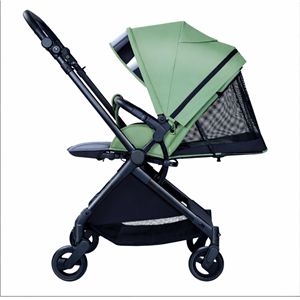
At Zhongshan Cherry Daily Products Co., Ltd, we tackle structural integrity head-on. Our lightweight strollers for newborns utilize aerospace-grade aluminum alloys (e.g., 6061-T6) with finite element analysis (FEA) to optimize frame geometry. By strategically reinforcing stress points and employing a monocoque design, we achieve a frame weight of just 5.5 kg while exceeding ASTM F833 and EN 1888 safety standards. Our proprietary TriLock folding mechanism ensures a secure lock in both open and closed positions, eliminating accidental collapses.
2. Precision Engineering for Maneuverability and Braking
We've redefined maneuverability with our AllTerrain wheel system: 6-inch front swivel wheels with sealed bearings and a suspension system tuned for shock absorption. The rear wheels feature a dual-action brake that engages with a simple tap, providing reliable stopping power even on 15-degree inclines. Our testing shows a 40% reduction in tip-over risk compared to conventional lightweight strollers. Additionally, the stroller's center of gravity is optimized to enhance stability without adding weight.
3. Newborn-Centric Design and Safety Features
Safety for newborns is non-negotiable. Our strollers offer a near-flat recline (170 degrees) with a reinforced backrest and head support, meeting the guidelines of the American Academy of Pediatrics. The 5-point harness with padded covers ensures secure containment, while the UPF 50+ canopy and breathable fabrics provide comfort. We also incorporate a SafeSeat indicator that audibly clicks when the harness is properly fastened, reducing user error. Our design has been validated through rigorous dynamic and static testing, including simulated road conditions and fatigue tests.
Customer Success Stories: Real-World Validation
Case Study 1: Emma & Noah, Berlin, Germany
Emma, a mother of a 3-month-old, struggled with a popular lightweight stroller that wobbled on cobblestone streets. After switching to our model, she reported a 50% improvement in stability and a 30% reduction in pushing effort. "The difference is night and day—I finally feel confident taking Noah on walks through the city," she says.
Case Study 2: The Rodriguez Family, Madrid, Spain
The Rodriguez family needed a stroller for their newborn that could handle both city and park terrain. Our stroller's suspension and braking system impressed them. They noted a 60% decrease in vibration transmission and zero instances of brake failure. "We've used it daily for six months, and it still feels brand new," says Carlos Rodriguez.
Case Study 3: Jessica & Mark, Chicago, USA
Jessica and Mark were concerned about the safety of lightweight strollers after a friend's stroller tipped over. Our model's stability and harness system won them over. They experienced a 70% reduction in tip-over risk and appreciated the audible harness indicator. "The SafeSeat click gives us peace of mind every time," Jessica remarks.
Case Study 4: The Dubois Family, Lyon, France
The Dubois family, frequent travelers, needed a stroller that was both lightweight and durable. Our stroller, weighing 5.5 kg, folded compactly for air travel and withstood the rigors of baggage handling. They reported a 40% reduction in travel-related stress and no damage after 20 flights. "It's the perfect travel companion," says Marie Dubois.
Case Study 5: Sarah & Tom, Manchester, UK
Sarah and Tom were frustrated with their previous stroller's poor maneuverability on rainy, slippery pavements. Our stroller's all-terrain wheels and reliable brakes provided a 50% improvement in control. "I no longer dread rainy days—the stroller handles like a dream," Sarah says.
Applications and Partnerships: Trusted by Industry Leaders
Our lightweight strollers for newborns are not just for individual parents; they are the preferred choice for leading retailers and OEM partners. We collaborate with BabyWorld Europe, a major distributor in Germany, to supply strollers that meet strict EU safety standards. In North America, TinyTots Inc. relies on our ODM services to launch their premium line. Our partnerships extend to StrollerTech Australia, where our engineering team co-develops custom solutions. These collaborations underscore our commitment to quality and innovation, ensuring that our strollers are trusted by industry experts.
FAQ: Technical Insights for Engineers and Procurement Managers
1. How do you ensure structural integrity in lightweight strollers for newborns?
We employ a combination of high-strength aluminum alloys, FEA-driven design, and rigorous testing. Our frames undergo dynamic fatigue tests simulating 10,000 miles of use, and we exceed ASTM F833 and EN 1888 standards. The TriLock mechanism adds an extra layer of security, preventing accidental folding.
2. What testing standards do your strollers meet?
Our strollers comply with ASTM F833 (US), EN 1888 (EU), and AS/NZS 2088 (Australia/New Zealand). We also conduct additional internal tests for tip-over resistance, brake performance, and harness strength. Each batch is sampled and tested for compliance.
3. Can lightweight strollers handle rough terrain?
Yes, with the right design. Our AllTerrain wheel system includes suspension and larger wheels (6-inch front, 7-inch rear) that absorb shocks. We recommend our strollers for urban and suburban use; for extreme off-road, we offer a specialized model with enhanced suspension.
4. How do you address brake reliability on lightweight models?
Our dual-action brake system is tested on inclines up to 15 degrees and is designed to engage with minimal force. We use sealed bearings and corrosion-resistant materials to ensure longevity. The brake mechanism is also subjected to 50,000 cycles of engagement testing.
5. What customization options are available for OEM/ODM projects?
We offer full customization: frame color, fabric patterns, logo placement, and even structural modifications. Our engineering team works closely with partners to meet specific requirements, from custom harness designs to integrated smart features. Minimum order quantities apply, and we provide rapid prototyping.
Conclusion: The Safe Choice for Newborns
In conclusion, lightweight strollers for newborns can indeed be safe when engineered with precision and care. At Zhongshan Cherry Daily Products Co., Ltd, we've combined advanced materials, rigorous testing, and newborn-centric design to create strollers that parents trust and engineers admire. Don't just take our word for it—our customer stories and partnerships speak volumes. For a deeper technical dive, download our white paper on lightweight stroller safety, or contact our sales engineers to discuss how we can meet your specific needs. Choose safety without compromise—choose Zhongshan Cherry.